











Planning match analysis a day ahead gives you time to review the schedule without rushing. This page brings together tomorrow’s predictions across football, basketball and tennis, using statistical models that consider form, home and away records, scoring patterns and defensive strength. Every forecast is a probability estimate, not a certainty.

Whether you follow the NPFL, Premier League, NBA or ATP Tour, fixtures are arranged to make the relevant competitions easier to find. Depending on the sport, a listing may show win probabilities, expected goals, points information or a likely scoreline. Use those figures to structure your thinking rather than replace independent judgement.
How Tomorrow Predictions Are Built
The mathematical prediction model combines several layers of available data. Recent results, home and away performance, scoring averages and defensive records all help describe the likely balance of a fixture. A team that performs strongly at home may show a very different profile away from home.
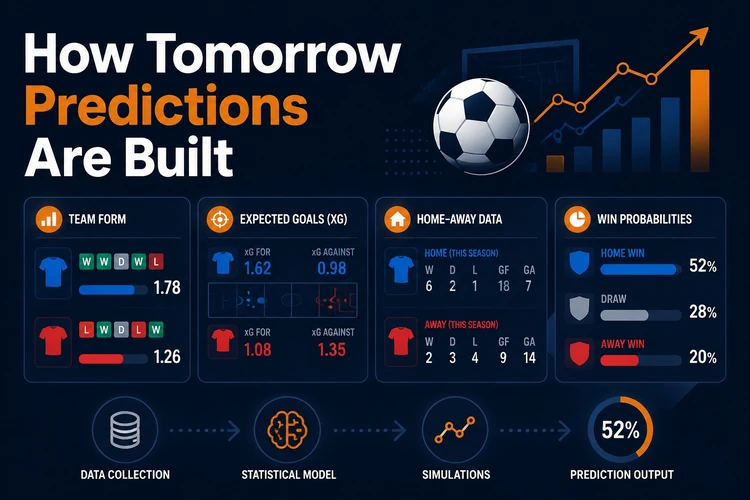
Scoring and conceding averages can feed an expected goals estimate, which describes how many goals each side may create rather than relying only on past scorelines. The model can then turn those estimates into probabilities for a home win, draw or away win and distribute likelihood across possible scores. A 70 percent probability still leaves a meaningful chance of another result.
Correct Score Predictions for Tomorrow
A correct score forecast identifies the exact final scoreline considered most probable and shows its estimated likelihood. In many football matches, even the leading scoreline is below 20 percent because several results remain plausible.
Read the scoreline beside the wider outcome probabilities. If a home win is rated at 65 percent and 2-1 is the leading score, the score forecast adds detail but does not confirm the result. Use it with form, expected goals and other match information rather than as a standalone conclusion.
Browsing Tomorrow's Fixtures by League
Tomorrow’s schedule can cover many competitions across several countries. Grouping fixtures by country and competition lets you move directly to the NPFL, English Championship or Spanish Segunda instead of scanning one mixed list.
International tournaments, domestic cups and youth competitions can appear in their own sections when fixture data is available. Kick-off times are displayed according to the site’s settings, so check the time zone before planning around a match. The sports section provides a wider view of available competitions.
Football Predictions Tomorrow
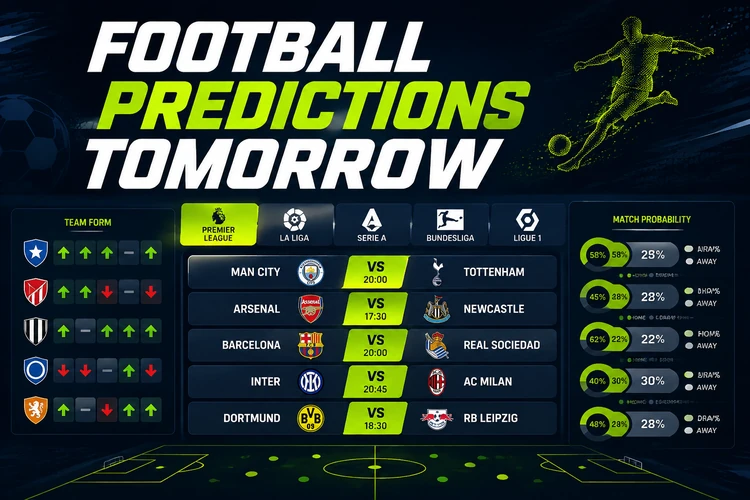
Football has the broadest range of fixtures, from major European leagues to competitions in Africa, South America and Asia. Nigerian readers can compare NPFL and CAF fixtures with matches from larger international leagues where data is available.
Listings may include win-draw-win probabilities, a goals estimate and the most likely score. For lower-profile or youth competitions, thinner historical data can widen uncertainty, so compare the figures with team news and recent performances.
Basketball Predictions Tomorrow
Basketball analysis focuses on points averages, pace, recent form and results at the same venue. NBA fixtures are common, while EuroLeague, NBL and selected national competitions may appear when fixtures are scheduled.
Unlike football, the forecast is normally a two-way comparison between the teams because a drawn final result is not expected after overtime rules are applied. A 55-45 split indicates a close contest, not a strong signal.
Tennis Predictions Tomorrow
Tennis coverage includes ATP and WTA events, as well as Challenger and ITF tournaments when fixtures are available. Useful indicators include surface win rate, service performance, head-to-head history and recent results.
There is no draw outcome in a completed tennis match, so the listing shows each player’s estimated chance of winning. Grand Slam and Masters events often provide richer data, while forecasts for lower-ranked players may carry greater uncertainty.
Comparing Today and Tomorrow Predictions
Today’s fixtures may have more current information, including confirmed line-ups, late injuries and recent odds movement. Tomorrow’s figures are more useful for early planning, but they may change when team news or fixture details change.
Looking across both days can reveal scheduling factors, such as a midweek cup match before a league fixture. The today section is useful for checking results and comparing how earlier forecasts performed, without treating past accuracy as a guarantee of future results.
How to Use Predictions Responsibly
Every figure is a probability estimate based on historical data and statistical modelling. Injuries, tactics, officiating decisions and unexpected events can change a match, so no forecast guarantees an outcome. An 80 percent estimate still allows the less likely result to occur.
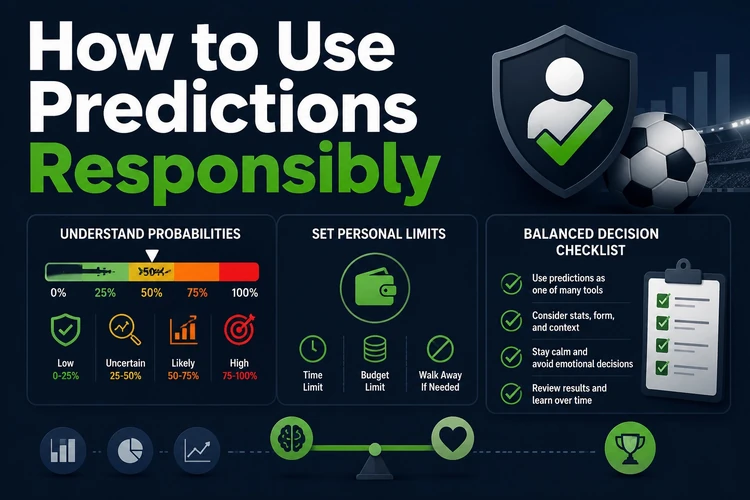
Use the numbers to organise research, not to remove uncertainty. If you include forecasts in betting decisions, set a clear spending limit, avoid chasing losses and take breaks. The responsible gambling page offers further guidance and support resources. 18+
Frequently Asked Questions
It is a daily-updated section showing statistical forecasts for fixtures scheduled for the following day. Depending on the sport, a listing may include win probabilities, expected goals and a likely score estimate based on recent form, home and away records and scoring patterns.
The model combines recent results, scoring averages, defensive records and home and away performance to produce probabilities. It estimates how often each possible outcome might occur in similar conditions. The result is a percentage, not a certainty.
Forecasts can refresh when new fixture information or relevant team data becomes available. Many next-day listings are settled by the evening before, but late injuries, lineup news or schedule changes can affect the figures.
Fixtures are grouped by country and competition, allowing you to move to the league or tournament you follow. International competitions may be separated from domestic leagues, depending on how the schedule is arranged.
It identifies the exact final scoreline with the highest estimated probability for a football match. Even the leading score can have a relatively low percentage because many scorelines are possible, so it should be read alongside the broader outcome probabilities.
Yes. Basketball forecasts can show a two-way win probability for scheduled fixtures, while tennis listings cover ATP, WTA, Challenger and ITF events when available. Surface, recent form, head-to-head records and other sport-specific data help inform tennis estimates.