











Forebet prediction offers football fans a way to examine upcoming matches through statistical analysis. Instead of relying only on gut feelings or team reputation, the platform applies mathematical models to historical data and current performance indicators. Nigerian football enthusiasts can use these forecasts to study form, compare likely outcomes, and follow competitions with a more structured approach.
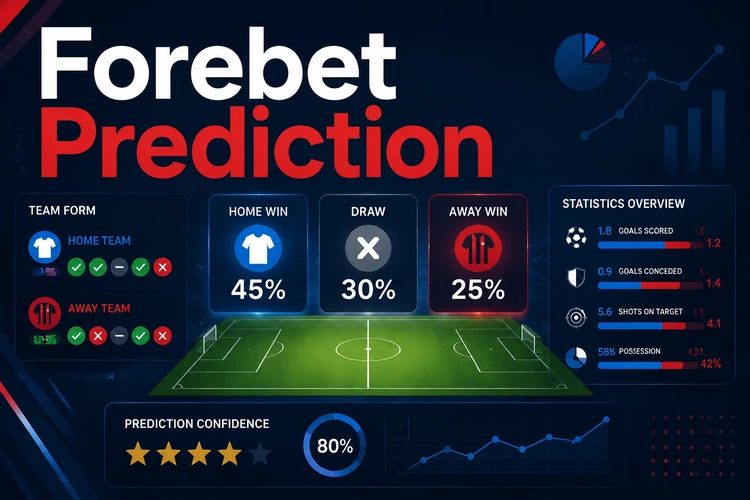
This guide explains how the forecasts are created, which information can influence the calculation, and why probability-based analysis differs from a guaranteed outcome. Whether you follow the Premier League, La Liga, or Nigerian competitions, understanding the logic behind the numbers helps you use them as research rather than as a substitute for judgement.
Understanding Forebet Prediction
Forebet prediction is a football forecasting service built around statistical algorithms rather than subjective opinions. It brings together match results, scoring records, home and away performance, league position, and other historical indicators. A fixture may receive probabilities for a home win, draw, away win, total goals, both teams to score, and a possible correct score.
The available coverage spans major European leagues, international tournaments, and a selection of domestic and regional competitions. Coverage can vary by competition and date, so a particular Nigerian fixture should be checked directly rather than assumed to be listed. Forecasts are generally presented in a format that lets readers compare the main result with supporting goal and scoring markets.
Predictions are updated as fixtures and new results enter the underlying data. This makes the timing of a check relevant: information viewed several days before kickoff may not reflect a late lineup change or a recent match. The today's predictions page is useful for reviewing fixtures scheduled for the current day.
How Mathematical Predictions Are Created
A mathematical football prediction begins with probability analysis. The model can process team performance, previous results, goal averages, home and away records, league position, and longer-term trends. Expected goals, usually shortened to xG, estimate the quality of chances created and allowed; they can add context that a simple scoreline does not show.
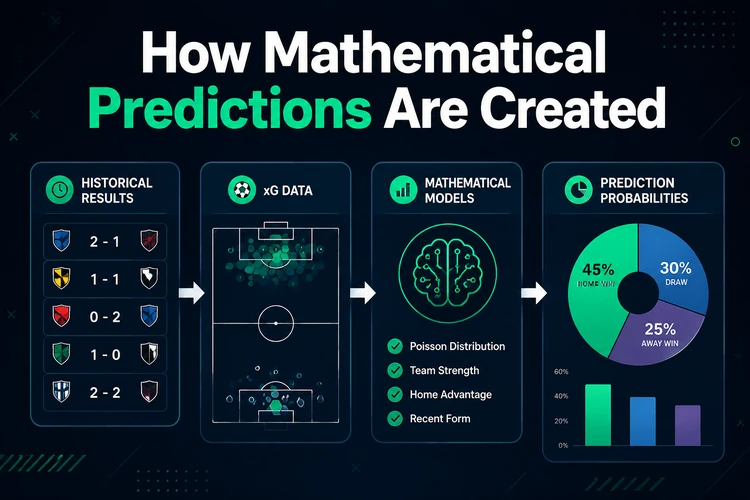
Head-to-head history may be included, but it should not be read in isolation. A meeting from several seasons ago may have little relevance if the managers, players, or divisions have changed. Recent form, strength of opposition, tactical style, and squad continuity usually provide more useful context when read alongside older records.
Home advantage is another common input. Teams may create more chances at home, while travel and unfamiliar conditions can affect away performance. The model combines these factors and assigns percentages to possible results. For example, a 70% home-win probability means that comparable situations have favoured the home side more often; it does not mean the result is predetermined.
Models can also reflect average goals, defensive strength, clean-sheet frequency, and the distribution of previous scorelines. They cannot fully measure every event before kickoff, and they do not remove uncertainty from the sport. A forecast should therefore be treated as an estimate of likelihood, not a promise.
Football Predictions Across Multiple Leagues
Football forecasts can cover competitions with very different playing styles and data quality. The English Premier League, Spanish La Liga, German Bundesliga, Italian Serie A, and French Ligue 1 often provide extensive historical records. International fixtures and African competitions may also appear, while lower divisions can have less consistent information.
League context matters when reading a percentage. A high-scoring competition may produce different goal expectations from a league where teams defend deep and matches finish with fewer chances. Comparing figures across leagues without considering that context can lead to an unfair conclusion about which team or market is stronger.
For fixtures on the following day, tomorrow's predictions can help with early research. Recheck the match closer to kickoff, particularly when the fixture is affected by travel, a congested calendar, or uncertain player availability.
Soccer Predictions and Betting Markets
Football and soccer are regional names for the same sport. The terminology does not change how a statistical model evaluates a match. Common markets include the 1X2 result, total goals over or under a line, both teams to score, and correct score.
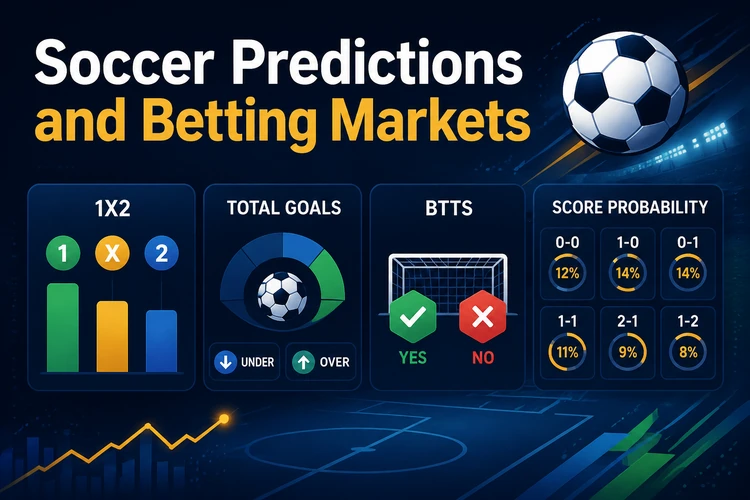
A match can show a strong probability for over 2.5 goals while giving neither team a dominant chance of winning. These are separate questions: one concerns the total number of goals, while the other concerns which side takes the points. Similarly, a high BTTS probability does not identify the winner. Reading each market on its own prevents false connections between unrelated percentages.
Correct-score forecasts are more specific and consequently more sensitive to small events. An early goal, penalty, dismissal, or tactical change can quickly make a precise scoreline unlikely. Use such figures as an illustration of the model's preferred scenario rather than as a reliable instruction.
Using Betting Tips Responsibly
Statistical tips are analytical tools, not decision-makers. Before acting on a forecast, check injuries, suspensions, expected lineups, recent performances, and the quality of the opposition. A model may not immediately reflect a late change, a player returning from a long absence, or a manager rotating the squad.
Betting odds provide a separate reference point. Comparing an implied probability with a model estimate can show where the market and the forecast differ, but a difference is not proof of value. Odds can incorporate current information, margin, and public demand, so they should be examined with care rather than treated as confirmation.

Responsible use means setting a budget before making any decision and keeping betting activity separate from essential household spending. Do not chase losses, borrow money, or raise stakes after a disappointing result. Anyone who feels unable to keep to personal limits should stop and seek support; the responsible gambling information page offers further guidance.
Advantages of Statistical Predictions
Statistical forecasts are useful because they impose a consistent method on a subject that often attracts strong opinions. Their practical advantages include:
- They process large amounts of historical match data quickly.
- They reduce the influence of club loyalty and emotional reactions.
- They present uncertainty as percentages instead of vague confidence.
- They allow several fixtures to be compared using the same framework.
- They bring attention to less publicised leagues and competitions.
- They combine scoring and defensive information in one assessment.
- They help readers distinguish a likely result from a possible result.
- They provide a starting point for checking team form and trends.
- They make goal markets easier to examine alongside the main result.
- They can reveal when a popular opinion is not strongly supported by the data.
These advantages are strongest when the reader checks the assumptions behind a forecast. Numbers are more informative when paired with match context, rather than copied without examination.
Limitations of Mathematical Models
Even sophisticated algorithms cannot predict every variable in a football match. An injury during warmup, a controversial refereeing decision, an unexpected formation, or an individual moment of skill can change the game. Heavy rain and strong wind may also affect passing, shooting, and the total number of chances.
Motivation is difficult to quantify. A team facing relegation may approach a match with unusual urgency, while a side with little left to play for may rotate its squad. New managers, travel problems, changing surfaces, and pressure from a derby can introduce information that historical averages do not capture well.
There is also a difference between model accuracy and a profitable decision. A forecast can correctly identify the more likely team while the available odds offer little compensation for the risk. Review the probability, the price, and the uncertainty together. No forecast is ever certain, because football outcomes depend on human performance and random events.
Reading a Prediction Clearly
Start with the match date, competition, and teams before looking at the suggested outcome. Confirm that you are reading the correct fixture, especially when clubs have similar names or play more than once in a short period. Then review the main result, goal expectation, and any available supporting statistics.
Look for differences between recent form and the longer record. Five recent matches can reveal a current change, but they may also be affected by unusually strong or weak opponents. A balanced review asks whether the same pattern appears in home and away figures, scoring rates, defensive results, and the team's schedule.
Finally, record your reasoning before the match if you are studying forecasts over time. Comparing the forecast with the actual result can teach you about variance and improve your understanding of probability. It is more useful than judging a model from one successful or unsuccessful prediction.
FAQ
Forebet prediction is a football forecasting service that uses statistical algorithms and historical data to estimate the probability of different match outcomes. It can present figures for results, goals, and both teams to score, but it does not remove uncertainty.
A mathematical football prediction applies probability models to information such as team performance, previous results, goal averages, home and away records, and expected goals. It produces likelihood estimates rather than a guaranteed result.
The draft describes Forebet as providing free access to its football forecasts and statistical information. Availability and features can change, so readers should check the current service presentation for the latest details.
Forecasts are generally updated as fixtures and new performance data become available. Checking close to kickoff can provide a more current view, although late injuries, lineups, and match events can still change the outlook.
Coverage can include African competitions and some domestic fixtures, but the availability of a particular Nigerian match may vary by date and competition. Check the fixture list directly rather than assuming every local game is included.
No prediction system is accurate for every match. Statistical models estimate probability, so a 70% likelihood still describes situations in which the outcome fails to occur. Accuracy should be assessed over many fixtures, not from one result.
Yes. Beginners can use the percentage displays to learn how form, scoring, and home advantage are considered. New users should compare the forecast with current team information and avoid treating it as a betting instruction.
There is no difference in the sport being analysed. Football and soccer are regional names for association football, and the same match markets can be described using either term.
Treat a tip as an estimate based on available data. Check team news, lineup changes, injuries, odds, and the importance of the fixture before drawing a conclusion. A tip is not a guarantee or a replacement for independent judgement.
No. Mathematical forecasts calculate likelihoods, while the match itself is affected by injuries, referee decisions, weather, tactics, and random events. Even a high-probability outcome can fail.
Set a fixed budget and time limit before beginning, and never use money needed for essentials. Do not chase losses or increase stakes emotionally. Use forecasts as one research input and stop if betting no longer feels controlled.
Relevant inputs can include historical results, team performance, goal averages, home and away records, league position, recent form, head-to-head history, and expected goals. The exact data and weighting used by a service may change over time.